

Marble Run 3D
There’s something oddly hypnotic about watching a marble roll. It’s a simple physics toy from childhood—tilting a shoebox lid, building cardboard chutes, racing glass spheres down the hallway. Marble Run 3D from OSA Studio taps straight into that memory, then amplifies it with neon-lit tracks, chaotic multiplayer, and the pure satisfaction of slamming a rival marble clean off the edge at 200 mph.
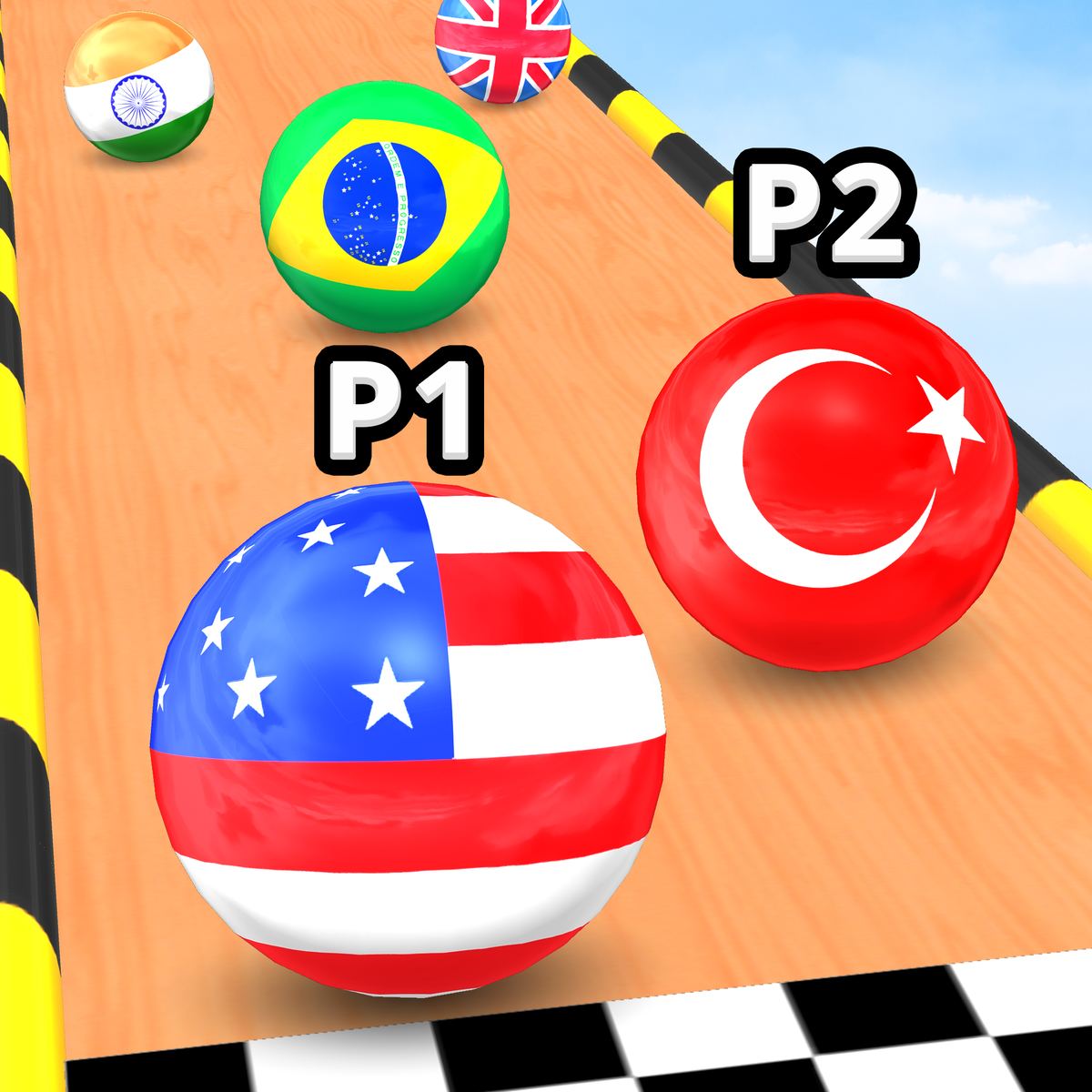
The premise is simple: pick a marble in your country’s colors, line up against a pack of opponents, and race to the finish. The tracks twist, dip, and narrow in ways that demand your full attention. One lazy moment and you’re tumbling into the void while three other marbles zip past. It’s the kind of browser game that hooks you with a quick “just one race” and then eats forty-five minutes before you even notice.
What brings people back is the collision system. This isn’t a polite time-trial where everyone stays in their lane. You actively bash into other marbles, sending them flying off ramps or pinballing into barriers. There’s real strategy in knowing when to draft behind someone and when to make your move. The ragdoll physics on knocked-out opponents are genuinely hilarious. With over 328,000 likes on Poki, the game clearly struck a nerve with players who want their racing a little more chaotic than your average track sim.
How to Play
The objective is straightforward: reach the finish line before everyone else. You’ll race on elevated, winding tracks suspended over open space. Fall off, and you respawn—but you lose precious time and momentum. Every fraction of a second counts.
Desktop controls use either A/D keys or the left/right arrow keys. These shift your marble left and right across the track. That’s it—no accelerate button, no brake. Your marble rolls forward on its own. Your entire job is steering, which sounds easy until the track curves sharply and three opponents are jostling you from both sides.
Mobile and tablet controls work through touch. Slide your finger across the screen (or move your cursor on a trackpad) to guide the marble. The game responds to the position of your input relative to the track. Small, deliberate movements work better than frantic swiping.
The beauty of the control scheme is its simplicity. You can hand someone the game and they’ll understand it in seconds. Mastering it, though—that takes a while.
Game Modes
Marble Run 3D offers two main ways to play, each serving a different purpose.
Race Mode is the core experience. You’re thrown into a multiplayer field and compete against other marbles—some controlled by AI, some by real players—on dynamically designed courses. The tracks get progressively more complex as you keep playing. They introduce steeper drops, sharper turns, and narrower passages where one wrong nudge sends you plummeting. Knocking opponents off the track isn’t just encouraged; it’s pretty much essential if you want first place on the harder courses.
Challenge Mode strips away the competition and lets you focus purely on course navigation. Think of it as a practice arena. No opponents to dodge, no pressure to podium—just you, the track, and a chance to learn the layout of trickier sections. It’s the mode I’d recommend starting with if you’re brand new. It gives you room to figure out how the marble handles on tight corners without getting blindsided by a pack of racers.
There’s also a country selection element at the start. You pick your nation’s marble, and it’s displayed as you race. It’s a small touch, but it adds a bit of national pride to the proceedings—and bragging rights when your marble crosses the line first.
Tips and Strategies
Early on, stick to the middle. The first few seconds of any race are a mess of marbles jostling for position. Resist the urge to weave aggressively. Keeping to the center of the track protects you from getting nudged off the sides by someone else’s wild steering. Let the reckless players eliminate themselves.
Use the walls as bumpers, not enemies. When the track narrows, brushing against a wall is far better than drifting off the open edge. New players tend to overcorrect away from walls and launch themselves into empty space. Get comfortable riding close to the rails—it’s safer than you think.
Learn when to bump and when to draft. Knocking an opponent off the track feels great, but going out of your way to do it can cost you speed and positioning. Sometimes the smarter play is to tuck in behind a leading marble and let them clear the path for you. Then, when the track widens or a ramp appears, make your move.
Watch the track ahead, not just your marble. This sounds obvious, but the temptation to stare at your marble and react to immediate threats is strong. The real danger is the curve that’s three seconds ahead. Keeping your eyes up the track gives you time to position smoothly instead of panic-steering at the last instant.
Challenge Mode is your best friend. Seriously. If you keep wiping out on a particular section—a tight spiral, a narrow bridge, a jump—go practice it without opponents breathing down your neck. Five minutes in Challenge Mode will teach you more than twenty races of fumbling through the same obstacle.
Common Mistakes
Oversteering on straightaways. The controls are responsive, and many players develop a nervous habit of constantly wiggling left and right even on wide, straight sections. This does nothing productive and often causes you to clip a wall or veer off at the transition into a curve. Stay still when the track lets you.
Ignoring the respawn penalty. Falling off the track doesn’t end your race, but the respawn eats time and resets your momentum. Treat the edge of the track like it’s made of lava. Every fall costs you positions, and on tighter courses, recovering from even one fall is tough.
Chasing kills instead of running the race. It’s tempting to target a specific opponent and try to knock them off, especially if they bumped you earlier. But tunnel vision on one marble means you stop watching the track. Players who fixate on revenge usually end up falling off themselves while their target sails ahead.
Not using Challenge Mode. A lot of players jump straight into Race Mode and stay there, learning through trial and error. That works, but it’s slow and frustrating. Challenge Mode exists for a reason—use it to build confidence before going head to head.
FAQ
Is Marble Run 3D free to play?
Yes. The game runs entirely in your browser with no download required and no paywall. You can play it on Poki without creating an account.
Can I play on my phone?
Yeah, it plays on desktop, phones, and tablets. The touch controls are smooth enough that mobile play doesn’t feel like a downgrade.
Are the other racers real people or bots?
The race field is a mix. You’ll encounter AI-controlled marbles alongside real players, and the blend varies from race to race. The AI opponents are competent enough to keep races competitive even when the lobby is light on human players.
Who made Marble Run 3D?
OSA Studio developed the game. They’ve also made other browser titles including Smash It, Zombroad, Color Pencil Run, and Draw Wire.
Does the game save my progress or stats?
Marble Run 3D is designed as a pick-up-and-play experience. Your country selection and general familiarity with the tracks carry over through practice, but there isn’t a deep progression system with unlocks or ranks. Each race is its own self-contained competition.
Marble Run 3D doesn’t try to be anything it’s not. It’s fast, loud, physics-driven chaos on a browser game budget—and sometimes that’s exactly what you need during a ten-minute break.