

12 Mini Battles 2
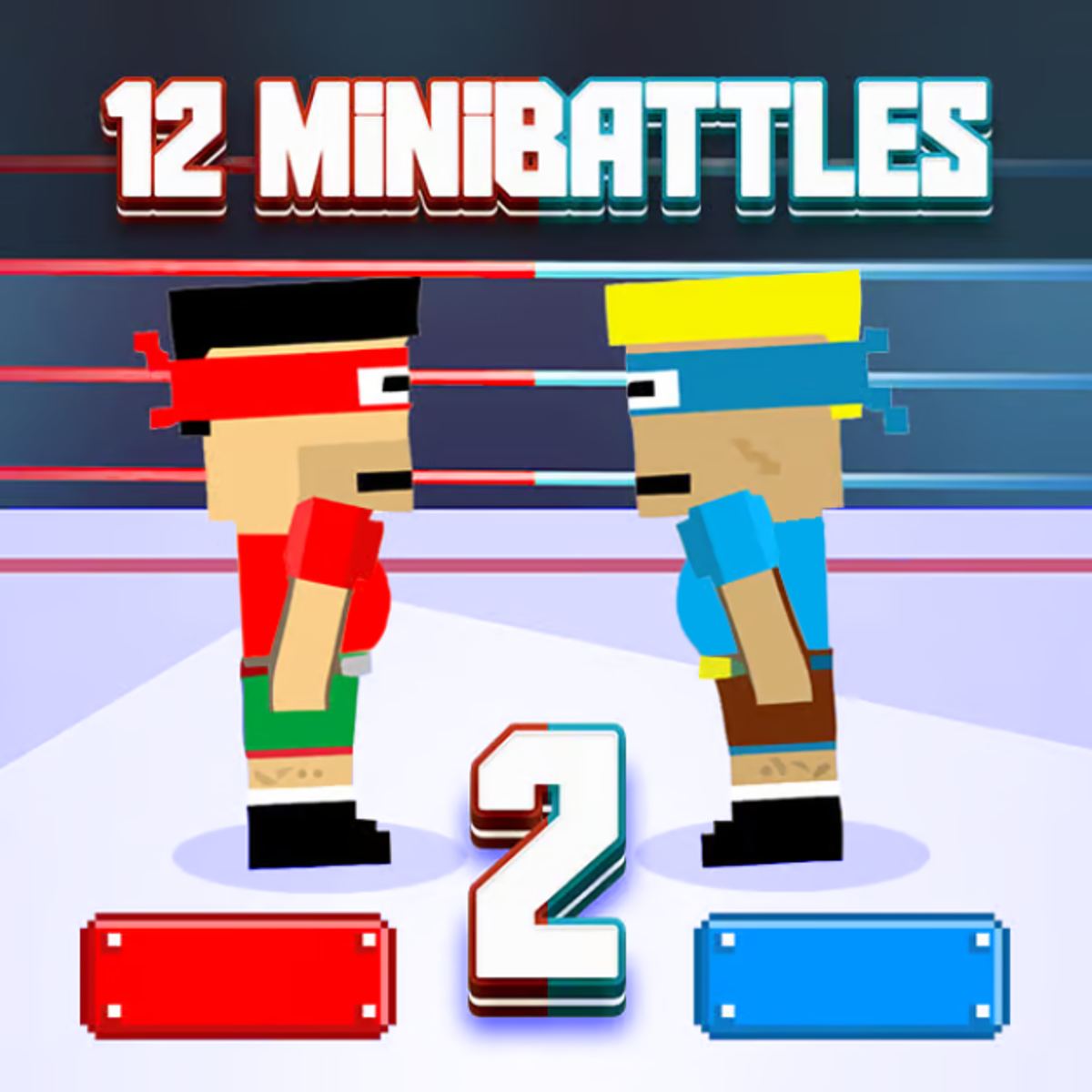
Got a friend on the couch and ten minutes to burn? 12 Mini Battles 2 turns a short break into a grudge match. It’s a local multiplayer party game—no online, no bots, just two people on the same screen trying to outdo each other in a rapid-fire series of silly, stressful, and surprisingly fun mini-games. The sequel to 12 MiniBattles (also by Shared Dreams Studio) keeps the one-button-per-player setup but swaps in new challenges: street racing, duck shooting, table football, and more.
The hook is simplicity. Each mini-game uses exactly one key per player—Player 1 presses A, Player 2 presses L. That’s it. No tutorial, no menu to navigate. You hit play, the game picks a random mini-game, and suddenly you’re shooting hoops, dodging traffic, or slapping a tiny ball past your opponent. The whole thing is over in about the time it takes to microwave a burrito, but the randomness keeps it from getting stale. You never know what’s coming next, and that unpredictability is half the fun.
It’s not a deep game. It’s not trying to be. What it does is take the “couch versus” energy of old-school party games and shrink it down to browser-sized proportions. No download, no sign-up, just pick a friend and go. And because it’s free on Poki, there’s zero barrier to entry. You can lose five rounds and still feel like you want “one more” before your lunch break ends.
How to Play
The objective is straightforward: win more mini-games than your opponent. Each round randomly picks one of twelve activities, and the winner gets a point. After all twelve mini-games have been played (or however many you decide to go through), the player with more wins takes the crown.
Desktop controls:
- Player 1: Press the A key.
- Player 2: Press the L key.
That’s literally it. Every mini-game uses that single button. What changes is how you use it. In basketball, timing your press determines the arc of your shot. In the racing game, tapping repeatedly makes your car go faster. In the duck shooting gallery, a quick press fires your gun. The game rarely tells you the exact mechanic upfront—you learn by losing, usually within the first two seconds.
Mobile controls:
On a phone or tablet, each player gets a touch button on their side of the screen. Player 1 taps on the left, Player 2 on the right. Same rules: one tap per action. The touch controls work fine for most games, though precision suffers in the faster challenges like racing or reflex-based ones. Still, it’s playable and responsive enough for casual rounds.
Before each mini-game starts, a brief screen shows the name and a simple icon. There’s no practice mode—you’re thrown straight into the action. That’s by design. Part of the appeal is figuring out the rules on the fly while your friend is already two wins ahead.
Game Modes
Strictly speaking, there’s only one mode: local two-player versus. You pick a friend, the game picks a mini-game, and you play through the set. There’s no single-player mode, no tournament bracket, and no online matchmaking. This is a pure couch co-op (or couch versus) experience.
That said, you can decide how many mini-games to play. The default seems to be all twelve, but nothing stops you from stopping early if someone’s getting crushed. The game doesn’t have a settings menu for this—it just cycles through the list until you quit. Some players treat it like a best-of-seven or first-to-five informal rule. The game doesn’t enforce it, but that’s fine; it keeps things flexible.
If you’re looking for variety, the mini-games themselves are the real draw. Here’s a quick rundown of what you’ll encounter (spoiler-free, since half the fun is being surprised):
- Basketball: Time your button press to shoot. The defender (the other player) tries to block by pressing at the right moment.
- Street Racing: Tap rapidly to accelerate. First to cross the finish line wins.
- Duck Shooting: A gallery appears with moving targets. Press to shoot. Most hits wins.
- Table Football: Push a ball past your opponent’s goalie by pressing at the right angle.
- Others: There’s a climbing game, a sword duel, a boxing match, and a few more that mix timing, speed, and a little bit of luck.
None of them are deep. They’re snack-sized, and that’s exactly what makes the game work. You never have time to get bored because the next challenge is already loading.
Tips and Strategies
Even though each mini-game only uses one button, there’s a surprising amount of nuance. Here’s what I’ve learned from playing too many rounds:
For basketball: Don’t mash the button. Watch your player’s shooting animation. There’s a sweet spot in the arc where releasing the button gives you the best chance to score. If you’re defending, wait until the shooter’s arm is about to release, then press. Timing beats speed here.
For street racing: Mash fast, but not randomly. The car accelerates in pulses. If you press too early or too late, you lose momentum. A steady rhythm—about four taps per second—works better than frantic mashing. Also, don’t look at your car; watch the finish line marker.
For duck shooting: Don’t shoot at the first duck you see. Wait for a cluster. The game spawns ducks in waves, and you can fire multiple times, but each shot has a tiny cooldown. Aim for the center of the screen where most ducks cross. And don’t bother with the ones flying diagonally—they’re harder to hit and worth the same points.
For table football: The ball moves predictably. Instead of chasing it, position your player in the center of the field and press when the ball comes to you. Most new players overcommit and leave their goal open. Patience wins this one.
General advice: Learn the first two seconds of each mini-game. That’s usually enough to figure out the mechanic. If you lose the first round, you know what to do for the second. The game doesn’t shuffle the order—it goes through the twelve in a fixed sequence. So if you remember the order, you can prepare mentally. But that’s a pro move.
Also, don’t get tilted. Because the games are random and short, a bad start can feel like a blowout. But the next mini-game might be your strong suit. Stay calm, and you’ll catch up.
Common Mistakes
New players make the same errors over and over. Here’s what trips people up:
Over-mashing. In racing and climbing games, people think pressing faster is always better. It’s not. There’s a rhythm to each game, and going too fast actually slows you down. Try a steady beat instead of a panic tap.
Ignoring the opponent’s screen. In split-screen mini-games like basketball and table football, you can see what the other player is doing. Use that information. If you see them winding up for a shot, you can time your block. If they’re off balance, go on the offensive. A lot of players stare at their own character and miss the obvious tells.
Not adapting to mobile controls. On a phone, the touch buttons are smaller and less tactile. Players often press too lightly or miss the button entirely. If you’re on mobile, press firmly and make sure your thumb covers the whole button area. Also, hold the phone landscape—portrait mode cuts off the edges of the screen.
Giving up after losing three in a row. The mini-games are random, so a losing streak doesn’t mean you’re bad. It might just mean you got three games you’re unfamiliar with. Stick with it. The next one could be your specialty.
Not taking breaks. The game is addictive in short bursts, but after ten rounds your reflexes start to dull. If you’re losing to your friend and getting frustrated, take a thirty-second breather. Come back fresh.
FAQ
Can I play 12 Mini Battles 2 alone?
No. The game is strictly local two-player. There’s no AI opponent, no single-player mode. You need a second person on the same device.
Is there online multiplayer?
No. It’s local only. You share the same keyboard or touchscreen.
How many mini-games are there?
Twelve. The title isn’t lying. The exact list varies slightly between versions, but the core set includes basketball, racing, duck shooting, table football, and several others.
Is it free?
Yes. The game is available for free on Poki. No downloads, no payments, no ads that interrupt gameplay (though there are banners around the page).
Can I play on my phone?
Yes. The game supports mobile browsers with touch controls. Both players need to be on the same device, so it works best on a tablet or a phone held in landscape mode.
What happens if I refresh the page?
The game resets. Your score and progress are not saved. It’s a session-based game—play, finish, start over.
Grab a friend, pick a device, and see who’s better at twelve completely different things. You might find out you’re great at duck hunting and terrible at soccer. Or the other way around. Either way, you’ll probably want a rematch.