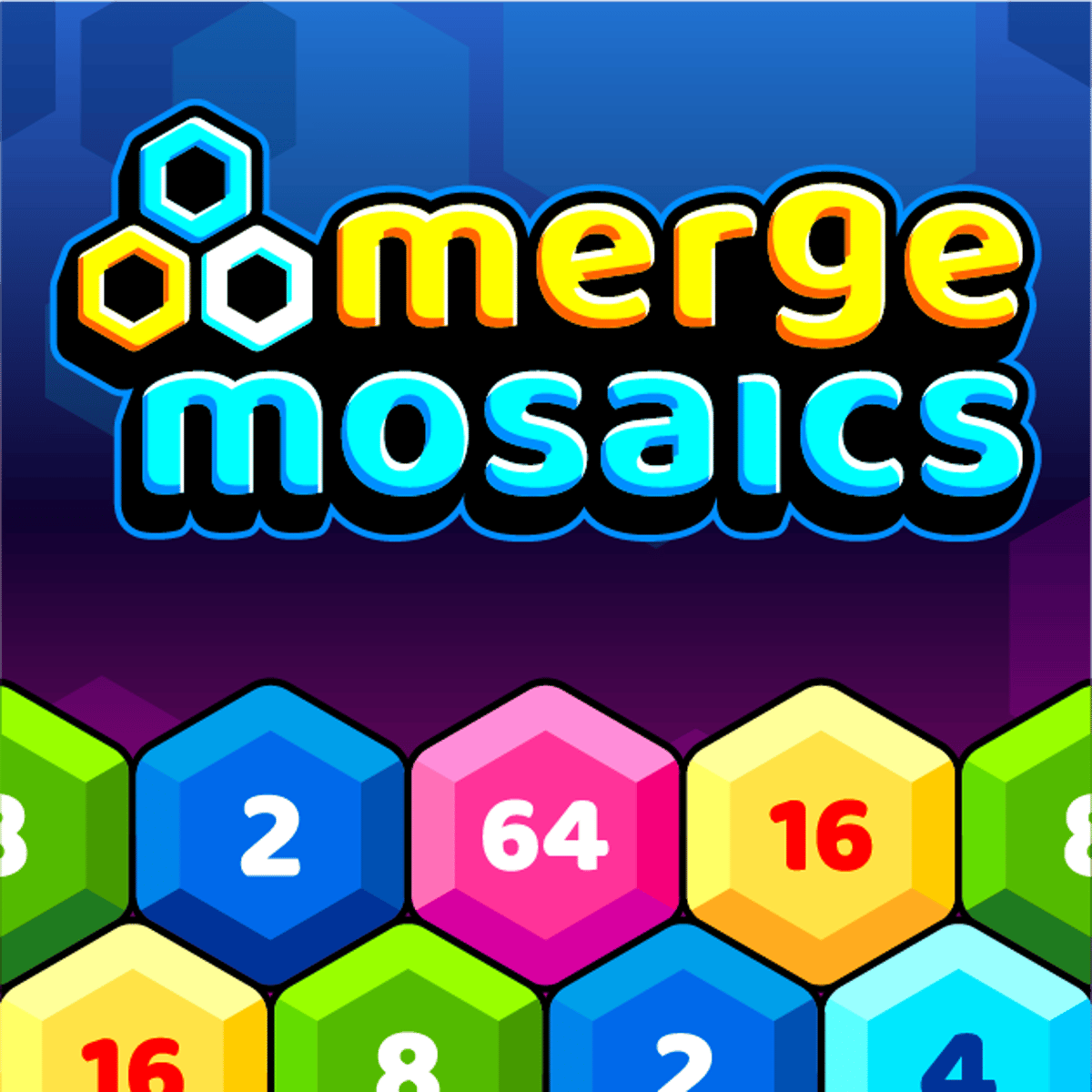








Merge Mosaics
Watching numbers grow is weirdly satisfying. You start with a few small tiles—a 1 here, a 2 there—and then, with a couple of smart moves, you’ve got a 32, then a 64, and before long the whole board is humming with digits that look like they belong in a spreadsheet. That’s the hook of Merge Mosaics, a browser puzzle that turns number matching into a quiet, compulsive addiction.
The premise is dead simple: a grid filled with numbered mosaic tiles. Tap or click three or more of the same number, and they merge into a single tile with a higher value. Rinse and repeat. But the catch—and there’s always a catch—is that the board fills up fast. New tiles drop in after every merge, and if you let things get too cluttered, you’ll run out of room and the game ends. So it’s not just about merging; it’s about planning where to put your next big combo, when to use a power-up, and how to keep your board breathing long enough to chase that elusive 1,000,000.
What keeps people coming back isn’t the numbers themselves—it’s the rhythm. You develop a sixth sense for which tiles to tap, when to hold off, and when to burn a bomb or a shuffle to save a run. It’s the kind of game you play while waiting for coffee, on the bus, or during a boring meeting, and somehow an hour disappears. The developer, Adgard, has a solid track record with casual puzzle games (they also made Pop It vs Spinner, Merge to Million, and a bunch of solitaire variants), and Merge Mosaics feels like their most polished number-merge effort yet.
How to Play
The Core Loop
You start with a small grid—maybe 6x6 or 7x7—and a handful of numbered tiles scattered across it. Your only move is to select a tile, then select another tile of the same number that is adjacent (horizontally or vertically, not diagonally). If you can connect three or more identical numbers in a chain, they merge into one tile with the next value. For example, three 2s become a single 3. Five 2s? You still get one 3, but the extra two tiles vanish—so bigger chains aren’t always more efficient, but they clear more space.
After each merge, the game spawns new tiles in random empty spots. Usually these are low numbers (1s and 2s), but as your average tile value climbs, you might see higher spawns too. The board gradually fills, and your goal is to keep merging before it overflows.
Controls: Desktop vs. Mobile
On desktop, you simply click a tile to select it. A highlight appears. Then click another tile of the same number that’s adjacent. If there’s a valid path of three or more identical tiles, the merge happens. You can also click and drag to select a chain, which some players find faster. On mobile, it’s the same idea: tap a tile, then tap the next in the chain. The game supports both portrait and landscape orientations, but portrait feels more natural on a phone.
There’s no timer, no score multiplier for speed. You can take as long as you want between moves. That’s part of the appeal—it’s a thinking game, not a reflex test.
The End Condition
The game ends when the board is completely full and you have no possible merges. That’s it. Your current highest tile value is recorded, and you can try again to beat it. There’s no traditional level progression; it’s a single endless mode that only stops when you mess up. The unofficial win condition is reaching a tile worth 1,000,000—a number that sounds absurd until you see someone pull it off.
Features
Merge Mosaics doesn’t have multiple game modes or a story, but it does have a few handy power-ups that make a real difference. You start each run with a small number of each, and you can earn more by watching ads or (on some platforms) through in-game achievements.
- Bomb: Removes a single tile of your choice. Use it to delete a high-number tile that’s blocking a merge, or to clear a 1 that’s taking up valuable space.
- Shuffle: Randomizes the positions of all tiles on the board. Great when you’re stuck and can see no possible merges—but it’s a gamble, because you might end up with an even worse layout.
- Swap: Lets you exchange the positions of two adjacent tiles. This is the most strategic power-up. You can use it to create a chain that wouldn’t otherwise exist.
You get a few free uses per run, and after that you can watch a short video to recharge one. The game is generous enough that you rarely feel forced to pay, but stingy enough that you have to think before using a bomb on a low-value tile.
There’s also a simple scoring system that tracks your highest tile ever, but no leaderboards or daily challenges. It’s a solitary experience, which fits the meditative mood.
Tips and Strategies
I’ve sunk more hours into this than I’d like to admit, and I’ve learned a few things that separate a 10,000 run from a 100,000 one.
1. Keep your board balanced. Don’t let all your high tiles cluster on one side. If you’ve got a 64 in the top-left corner and another 64 way down in the bottom-right, you’ll never merge them. Try to keep numbers of similar value close together. A good habit is to sweep your eyes across the board after every few moves and mentally note where your biggest tiles are.
2. Don’t merge everything immediately. Sometimes the best move is to wait. If you see three 4s in a line but merging them would create a 5 that lands in a spot surrounded by 1s and 2s, you’re better off holding off. Let the board fill a little, then look for a chain that includes those 4s plus another 4 that might appear. Patience is rewarded.
3. Use the Swap power-up to set up big chains. Swap is the most versatile tool. If you have two 16s separated by a single 3, swap the 3 with a 16 (if adjacent) and suddenly you have a triple. This is especially useful in the late game when tiles are large and board space is tight.
4. Prioritize clearing low numbers. Those 1s and 2s are clutter. They don’t help you reach a million. Whenever you have a chance to merge three 1s into a 2, or three 2s into a 3, do it. It clears space and brings you closer to the mid-range numbers where real progress happens.
5. Learn to read the board diagonally. Merges are only horizontal or vertical, but you can plan diagonally by moving tiles around. For example, if you have a 5 at (2,3) and another 5 at (4,5), you can’t merge them directly. But if you can shift one of them using swaps or by merging adjacent tiles, you might align them. Think of the grid as a sliding puzzle where every merge changes the landscape.
6. Don’t hoard power-ups. I used to save bombs for emergencies, but emergencies never came—I just got stuck. Use a bomb early to clear a tile that’s blocking a crucial chain. The game gives you more; don’t be afraid to burn one.
7. Aim for the center. High tiles in the center are easier to access from all sides. If you let your biggest tile sit in a corner, it becomes very hard to merge it with anything. Try to keep your highest-value tile within two steps of the center.
Common Mistakes
Even experienced players fall into these traps. Avoid them and your runs will last much longer.
Mistake #1: Merging the first thing you see. The game tempts you with easy merges, especially early on. But if you mindlessly tap every available triple, you’ll end up with a board full of mid-range tiles that are scattered and hard to combine. Instead, scan the whole board and prioritize merges that clear the most tiles or that set up future chains.
Mistake #2: Ignoring the edges. Tiles on the edge of the grid have fewer neighbors, which means fewer potential merges. If you let a high-value tile sit on the border, it’s almost impossible to connect it to other high tiles. Move it inward early by merging tiles around it.
Mistake #3: Using Shuffle as a panic button. Shuffle can save you, but it often makes things worse. If you’re stuck, first try to find any possible merge—even a small one—to open up space. Use shuffle only when you’ve exhausted all options and the board is completely locked. And even then, be prepared for a bad shuffle.
Mistake #4: Forgetting that merges don’t have to be straight lines. Three tiles in an L-shape still count as long as they are connected orthogonally. You can merge tiles that form a corner, a zigzag, or any shape where each tile touches the next. New players often overlook these non-linear chains.
Mistake #5: Not watching the spawn rate. As your average tile value increases, the game starts spawning higher numbers. If you have a board full of 32s and 64s, new tiles might be 8s or 16s. That’s good—they merge up quickly. But if you have a few 128s and the rest are 1s, the low numbers will clog the board. Keep the average high by merging low numbers as soon as possible.
FAQ
Q: What’s the highest number anyone has reached?
A: The game tracks your personal best, but there’s no global leaderboard. The theoretical maximum is limited by board size and randomness, but reaching 1,000,000 is considered the ultimate goal. Some players have posted screenshots of 512,000 or higher on forums, but it takes extreme patience and a bit of luck.
Q: Can I play Merge Mosaics offline?
A: Yes, once the game loads in your browser, it runs locally. You can play without an internet connection as long as the page is open. But if you refresh, you’ll lose your progress unless the game saves to local storage (which it does for your current run). Power-ups that require ad viewing obviously need a connection.
Q: Is there a time limit?
A: No. You can take as long as you want between moves. The only pressure is the board filling up.
Q: How do I get more power-ups?
A: You start each run with a few bombs, shuffles, and swaps. After using them, you can watch a short ad to get one more of each (usually one ad per power-up type per run). There’s no way to buy them with real money—the game is completely free.
Q: Why does the game sometimes spawn a tile on top of an existing one?
A: That shouldn’t happen. If you see overlapping tiles, it’s likely a bug. Refreshing the page usually fixes it. The game has had a few minor glitches reported, but nothing game-breaking.
Q: What’s the difference between Merge Mosaics and other number merge games like 2048?
A: The big difference is that you merge three or more tiles at once, not just two. And the board doesn’t slide; you select tiles individually. It’s slower and more strategic. Also, 2048 is grid-based with a fixed size; Merge Mosaics has a slightly larger board and power-ups, so it feels less claustrophobic.
Closing Thoughts
Merge Mosaics isn’t trying to reinvent the puzzle wheel. It’s a calm, methodical number merger that rewards planning over speed. The power-ups are useful without being overpowered, the controls work well on both phone and PC, and the 1,000,000 target gives you something to grind toward. If you’ve ever lost an afternoon to 2048 or Threes, this will scratch the same itch—just with a little more room to breathe. Give it a try when you have five minutes, and don’t be surprised if those five minutes turn into fifty.