


Sandtris
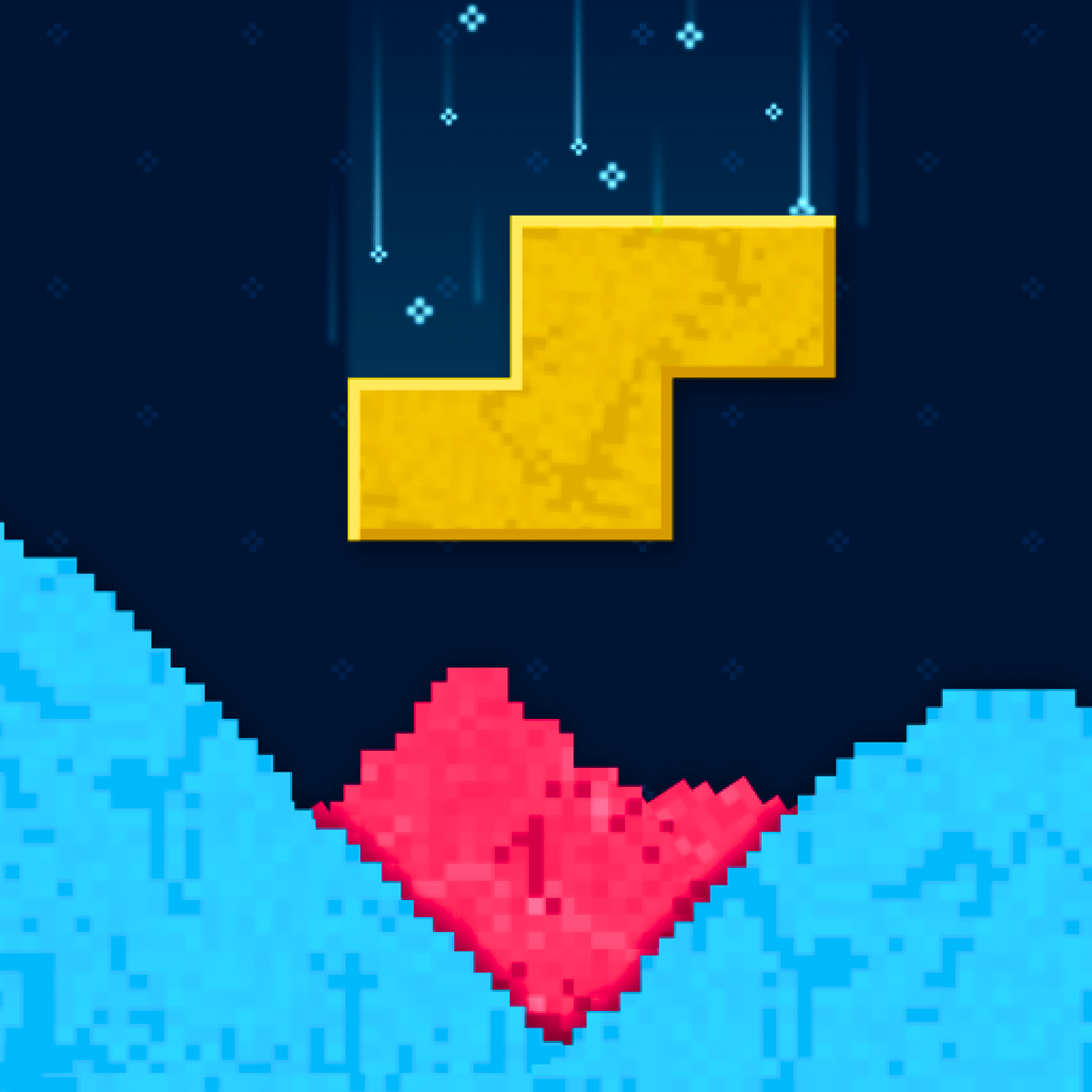
There’s something hypnotic about watching a block fall apart. Most puzzle games keep their pieces rigid—you drop a tetromino, it locks, you move on. Sandtris does the opposite. When a colored block lands, it doesn’t stay whole. It crumbles into a pile of individual sand grains, each one sliding and settling like the real thing. That small twist turns a familiar formula into something you can’t stop staring at.
The game takes the basic idea of clearing lines and adds a physics layer that changes how you think about placement. You’re not just stacking shapes anymore. You’re managing a flow of particles that can shift, spread, and leave gaps you didn’t plan for. It’s more chaotic than classic block puzzles, but that chaos is exactly what makes it addictive. You lose track of time, trying to set up one more clean line before the sand piles too high.
Sandtris launched in September 2024 and has already racked up over 58,000 ratings, sitting at a solid 4.0. That’s a strong start for a game that could have been just another Tetris clone. Instead, it feels fresh. Whether you’re killing five minutes on your phone or settling in for a longer session on desktop, the sand physics keep every drop interesting.
How to Play
The objective is simple: fill entire horizontal lines with sand to make them disappear. Blocks fall from the top of the screen, and when they hit the pile below, they break into sand particles. Those particles stack up, and you need to cover every cell in a row to clear it. If the sand reaches the top, it’s game over.
Desktop controls: Move your mouse left and right to aim where the block will fall. Click or tap to drop it faster. There’s no rotation—the blocks are fixed shapes, so your only control is horizontal positioning and timing.
Mobile controls: Swipe left or right to move the block. Tap to drop. The touch response is smooth, and the game adapts well to smaller screens. You can play one-handed without much trouble.
The key difference from standard block puzzles is that you can’t rely on pieces locking into perfect grids. Sand shifts. A block that lands on an uneven surface will spill grains into nearby empty spaces, sometimes filling gaps you didn’t intend. That can work for you or against you, depending on how you aim.
Let’s get specific. Imagine you drop a 2x2 square block onto a pile that’s higher on the left side. The block breaks apart, and the grains on the left slide down the slope, while the grains on the right stay put. That movement can either level out the surface or create a new dip. If you’re lucky, those sliding grains roll into a missing cell in the row below, completing a line. If you’re unlucky, they cascade into a gap you were trying to preserve for a future block.
The blocks themselves come in a handful of shapes: a single square, a 2x1 rectangle, a 2x2 square, a 3x1 line, and an L-shaped piece. Each shape breaks into a different number of grains. A 3x1 line, for example, produces three grains that spread out horizontally. That’s great for filling wide gaps but terrible for building height. The L-shaped piece is the trickiest—it creates an uneven distribution of sand, with more grains on one side. Dropping it carelessly can tilt your whole stack.
Because there’s no rotation, you have to think about which shape is coming next and where it will fit. The preview box in the corner shows the next block, so you can plan ahead. If you see a 3x1 line coming, you might want to flatten the top of your pile first. If a single square is next, you can aim for a narrow gap.
Game Modes
Sandtris offers two modes, and they change the experience significantly.
Classic Mode: This is the standard way to play. Blocks fall at a steady pace, and you have time to think about where to place them. The speed increases gradually as you clear lines, but it never feels rushed. It’s a good place to learn how sand behaves—how it settles, how it can bridge small gaps, and how one misplaced block can create a mess that takes several drops to fix.
In Classic mode, you can afford to experiment. I spent my first few games just watching the sand flow, trying to predict where each grain would end up. Sometimes I’d drop a block and see a grain roll three columns to the left, filling a hole I didn’t even know was there. Other times, a grain would get stuck on a tiny ledge and refuse to move, leaving a single empty cell that prevented a line from clearing. Those moments taught me to be patient. The game rewards observation.
The speed increase in Classic is gentle. You might clear ten lines before the pace picks up noticeably. That gives you room to recover from bad drops. If you make a mess, you can usually fix it by dropping blocks strategically. The sand physics are forgiving—they don’t punish you for imperfect placement the way a rigid grid would.
Speed Mode: Here, the blocks come faster from the start, and the pace ramps up aggressively. You don’t have the luxury of careful aiming. You need to make quick decisions and trust your instincts. Speed mode is where the game really tests your reflexes. It’s also where the sand physics become most chaotic, because you’re dropping blocks before the previous pile has fully settled. Grains are still sliding when the next block lands, and that unpredictability can either save you or bury you.
I remember one Speed mode run where I had a nearly full line, just one cell missing. A 2x1 rectangle was falling fast. I dropped it in the center, hoping the sand would spread. Instead, the grains bounced off a high pile and scattered in all directions, leaving the gap unfilled. The next block was a 3x1 line, and I panicked, dropping it too far left. That created a new mountain on the edge. Within three more blocks, the sand reached the top. It was frustrating, but it also taught me that Speed mode requires a different mindset. You can’t aim for perfection. You aim for survival.
There’s no endless mode or puzzle mode—just these two. That’s fine. They cover enough ground, and the replay value comes from chasing higher scores and cleaner clears. Classic mode is for learning and relaxing. Speed mode is for adrenaline. Both are worth your time.
Tips and Strategies
After a few dozen games, you start noticing patterns. Here’s what works.
Aim for the edges first. When you drop a block near the left or right wall, the sand has fewer places to spread. It tends to stack more vertically, which helps you fill lines faster. Dropping in the middle scatters grains in both directions, and that often creates uneven surfaces that are hard to fix.
Try this: in your next Classic game, force yourself to drop every block as close to the left wall as possible. You’ll notice the sand builds a tall, narrow column. That column will eventually spill into the center, but it gives you a solid foundation. Once the left side is high, switch to the right side. You’ll end up with two tall columns that gradually merge. That merging process fills lines naturally.
Watch the grain flow. After a block lands, take a half-second to see how the sand settles. Sometimes a grain will roll into a gap you didn’t notice, completing a line without you doing anything. Other times, a grain will slide away from where you wanted it, leaving a hole. If you pay attention, you can adjust your next drop to compensate.
For example, if you see a grain roll to the right, you know that area is lower. Drop your next block slightly to the right to feed that hungry gap. If a grain gets stuck on a high point, avoid dropping near that spot—you’ll only make the peak higher.
Don’t panic about small gaps. In classic block puzzles, a single missing cell can ruin your whole stack. In Sandtris, sand can fill those gaps naturally. A block dropped nearby might spill grains into the hole. So if you have a line that’s almost full, don’t stress about finding the perfect piece. Just keep dropping and let physics do some of the work.
I once had a line with two empty cells in the middle. I dropped a 2x2 square a few columns away, and one grain rolled across the surface and landed right in one of the gaps. The next block filled the other. That line cleared without me deliberately targeting it. The game rewards a relaxed approach.
Use the drop button sparingly. Dropping a block instantly feels satisfying, but it often leads to bad placement. The sand doesn’t have time to settle, and the block might land on an unstable pile that shifts after you’ve committed. In Classic mode, let the block fall slowly. Watch where it’s going to hit. Adjust at the last second if needed.
I’ve lost count of how many times I’ve dropped a block too fast, only to see it land on a peak and topple sideways. The grains scatter everywhere, creating a mess that takes three or four blocks to fix. Slow drops give you control.
In Speed mode, prioritize the center. When blocks are coming fast, you don’t have time to aim precisely at the edges. Drop everything in the middle. The sand will spread evenly, and you’ll fill lines more consistently. It’s not as efficient as edge-stacking, but it’s safer when you’re under pressure.
The center strategy works because the sand has room to spread left and right. You’ll create a dome-shaped pile, but that dome will eventually flatten out as you add more blocks. The key is to keep dropping quickly. Don’t hesitate. If you stop to aim, the next block will catch you off guard.
Clear lines in groups. If you can set up two or three lines to clear at once, do it. The game doesn’t give bonus points for combos, but clearing multiple lines at once gives you a brief breathing room. The sand level drops faster, and you have a moment to reset.
To set up a group clear, try to keep the surface as flat as possible. Avoid creating deep valleys or tall peaks. A flat surface means that when you drop a block, the sand spreads evenly, filling multiple rows at the same time. It takes practice, but once you get the hang of it, you’ll see lines disappear in clusters.
Use the preview to plan ahead. The next block is shown in a small box. Look at it before the current block lands. If the next block is wide (like a 3x1 line), you want a flat surface to drop it on. If it’s tall (like an L-shaped piece), you want to avoid dropping it where it will create a high peak. Planning one move ahead makes a huge difference.
I like to mentally mark where I want the next block to go. If the current block is filling a gap on the left, I know the next block will go to the right. That way, I’m never caught off guard.
Common Mistakes
New players tend to make the same errors. Avoid these.
Overthinking placement. Sand is unpredictable. You can spend ten seconds trying to position a block perfectly, and then a single grain rolls the wrong way and ruins your plan. It’s better to drop quickly and adapt than to freeze up. Speed mode forces you to learn this fast.
I’ve seen players stare at the screen for fifteen seconds, moving the block back and forth, trying to find the exact pixel-perfect spot. Then they drop it, and the sand does something unexpected anyway. Don’t be that player. Trust your gut. Drop the block and move on.
Ignoring the sides. Most people naturally drop blocks in the center because it feels safe. That creates a mountain in the middle and deep valleys on the edges. Those valleys are hard to fill because sand from center drops rarely reaches them. You end up with a lopsided pile that kills you quickly. Force yourself to aim for the sides, even if it feels awkward.
A good drill: play a game where you only drop blocks on the left half of the screen. Then play another where you only drop on the right half. You’ll see how the sand behaves differently near the walls. That knowledge will help you in real games.
Dropping too fast in Classic mode. The game doesn’t punish slow play in Classic. There’s no timer. So take your time. Rushing leads to sloppy placement, and sloppy placement leads to uneven stacks that are a nightmare to fix.
I once tried to speedrun Classic mode, dropping every block as fast as possible. I died within thirty seconds. The sand was all over the place, and I had no control. Slow down. Breathe. Let the sand settle.
Not watching the next block. The game shows you the upcoming block in a preview. Use it. If you see a wide block coming, you can prepare a flat surface for it. If a tall block is next, you know to avoid stacking too high in that column. Planning one move ahead makes a huge difference.
I’ve caught myself ignoring the preview many times. Every time I do, I end up with a block that doesn’t fit anywhere, and I have to drop it in a bad spot. The preview is there for a reason. Look at it.
Giving up after a bad drop. Sandtris is forgiving. A messy pile can often be salvaged if you keep dropping and let the sand settle into gaps. Don’t restart the moment things look ugly. Sometimes the game surprises you.
I had a game where my pile was a chaotic mess—peaks and valleys everywhere. I was sure I’d lose in the next few blocks. But I kept dropping, and somehow the sand started filling the valleys. I cleared three lines in a row and ended up with a high score. The physics can work in your favor if you give them a chance.
Dropping blocks too close to the edge in Speed mode. In Speed mode, the edges are dangerous. If you drop a block too close to the wall, the sand might pile up quickly and reach the top before you can clear a line. The center is safer because the sand spreads out. Save the edge-stacking for Classic mode.
Forgetting that sand settles over time. After a block lands, the grains keep moving for a second or two. If you drop another block before the sand settles, the new block can interact with moving grains in unpredictable ways. In Speed mode, this is unavoidable. But in Classic mode, wait for the sand to stop before dropping the next block. It gives you a clearer picture of the surface.
FAQ
Can I rotate the blocks?
No. Blocks fall in fixed orientations. Your only control is horizontal movement and drop timing. That’s part of what makes the game different from traditional block puzzles.
Is Sandtris free to play?
Yes. It’s free on Poki, with no ads interrupting gameplay. There are no microtransactions or pay-to-win mechanics.
Does the game work offline?
No. Sandtris is a browser game and requires an internet connection to load. Once it’s running, it doesn’t need constant data, but you can’t save it for offline play.
What happens when the sand reaches the top?
Game over. The screen fills with a “game over” message, and you can restart immediately. Your score is based on lines cleared, so try to beat your personal best.
Is there a leaderboard?
Not in the current version. You compete against your own high score. Some players track their progress manually, but there’s no global ranking.
Can I change the speed in Classic mode?
No. The speed increases automatically as you clear lines. You can’t adjust it manually.
Are there sound effects or music?
Yes, there’s a subtle background track and satisfying sound effects when blocks break and lines clear. You can mute them in the settings menu.
Does the game save my progress?
Your high score is saved in your browser’s local storage. If you clear your cache, it resets.
Can I play on a tablet?
Yes. The mobile controls work well on tablets too. The game scales to fit the screen.
Closing
Sandtris takes a simple idea—blocks that turn into sand—and builds a surprisingly deep puzzle game around it. The physics add just enough chaos to keep you on your toes, and the two modes offer different kinds of challenge. It’s easy to pick up, hard to put down, and perfect for those moments when you want something that feels familiar but isn’t. Give it a few rounds. You’ll probably lose track of time.
I’ve played dozens of puzzle games over the years, and Sandtris is one of the few that made me rethink how I approach the genre. The sand physics aren’t just a gimmick—they change the strategy at a fundamental level. You can’t rely on muscle memory from Tetris. You have to learn a new set of instincts. That learning process is frustrating at first, but once it clicks, the game becomes incredibly satisfying.
The best part? You can play it in short bursts. Waiting for a bus? Five minutes of Sandtris. Taking a break from work? Ten minutes. The sessions are short, but they leave you wanting more. That’s the mark of a good puzzle game.
So go ahead. Drop a block. Watch it crumble. See if you can beat your high score. Just don’t blame me when you’re still playing an hour later.