


Onet Paradise
If you've ever whiled away an afternoon clicking through a Mahjong Connect clone, you know the basic formula: match two identical tiles, clear the board, beat the clock. Onet Paradise takes that formula and gives it a tropical makeover—pineapples, flamingos, and coconuts instead of ancient Chinese tiles. It's simple, colorful, and the kind of game you start "just for five minutes" and somehow lose an hour to.
It's not deep strategy or a gripping story that keeps people coming back. It's the satisfying click of a successful match, the pressure of a ticking timer, and the quiet triumph of clearing a messy board. Potato Jam—the developer behind Onet Master and 1010 Color Match—knows how to make puzzles that feel good to solve. Onet Paradise is their most polished take on the classic matching genre, and it's been pulling in players since early 2020.
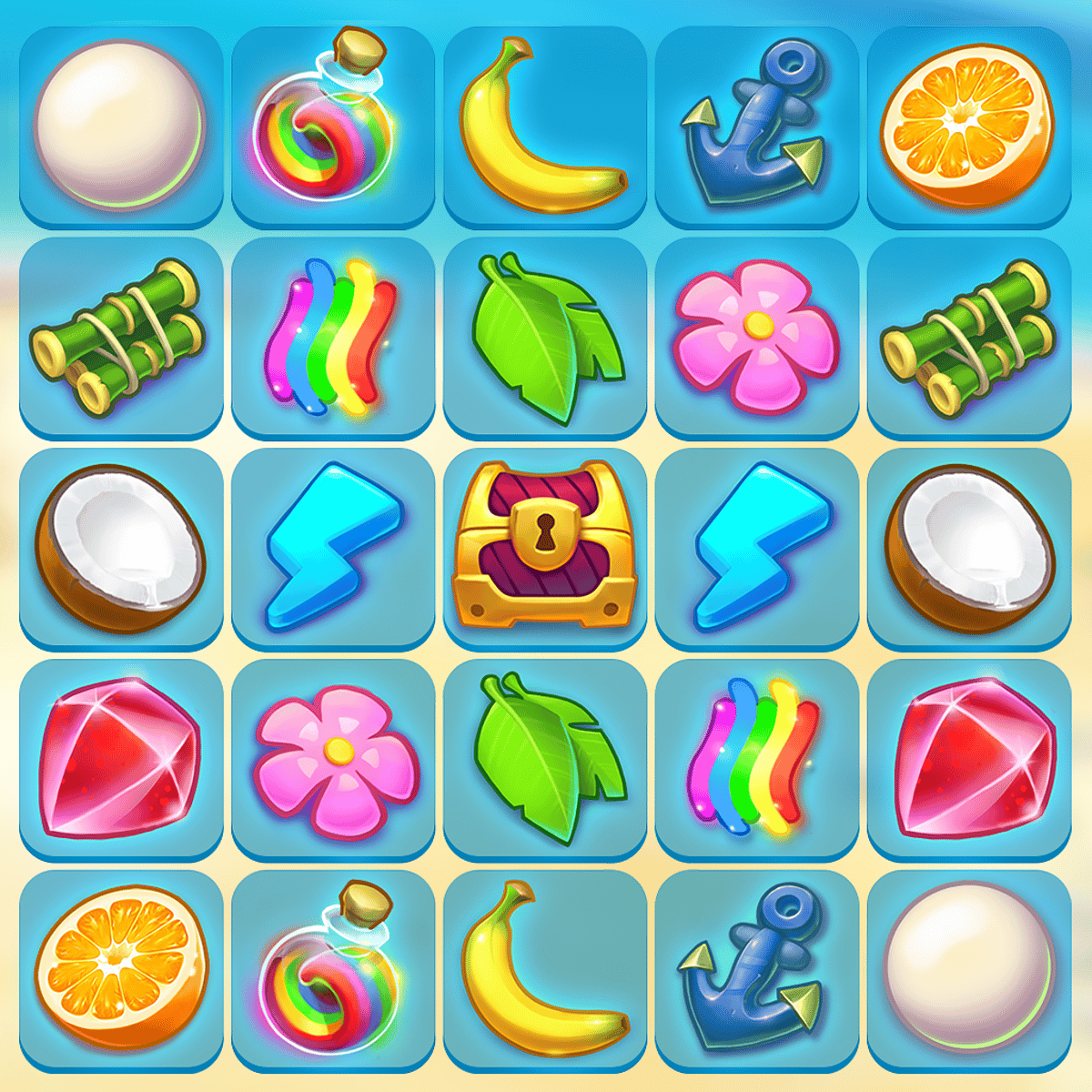
The tropical theme isn't just a coat of paint—it changes how you scan the board. Instead of abstract bamboo sticks or Chinese characters, you get bright, instantly recognizable icons: a yellow pineapple, a pink flamingo, a green coconut, a red hibiscus, a blue seashell, a purple orchid, a smiling sun, and a few others. Each icon has a distinct shape and color, so you can spot matches at a glance even when the board is crowded. That visual clarity matters when the timer is ticking down and your brain is already juggling half a dozen possible paths.
How to Play
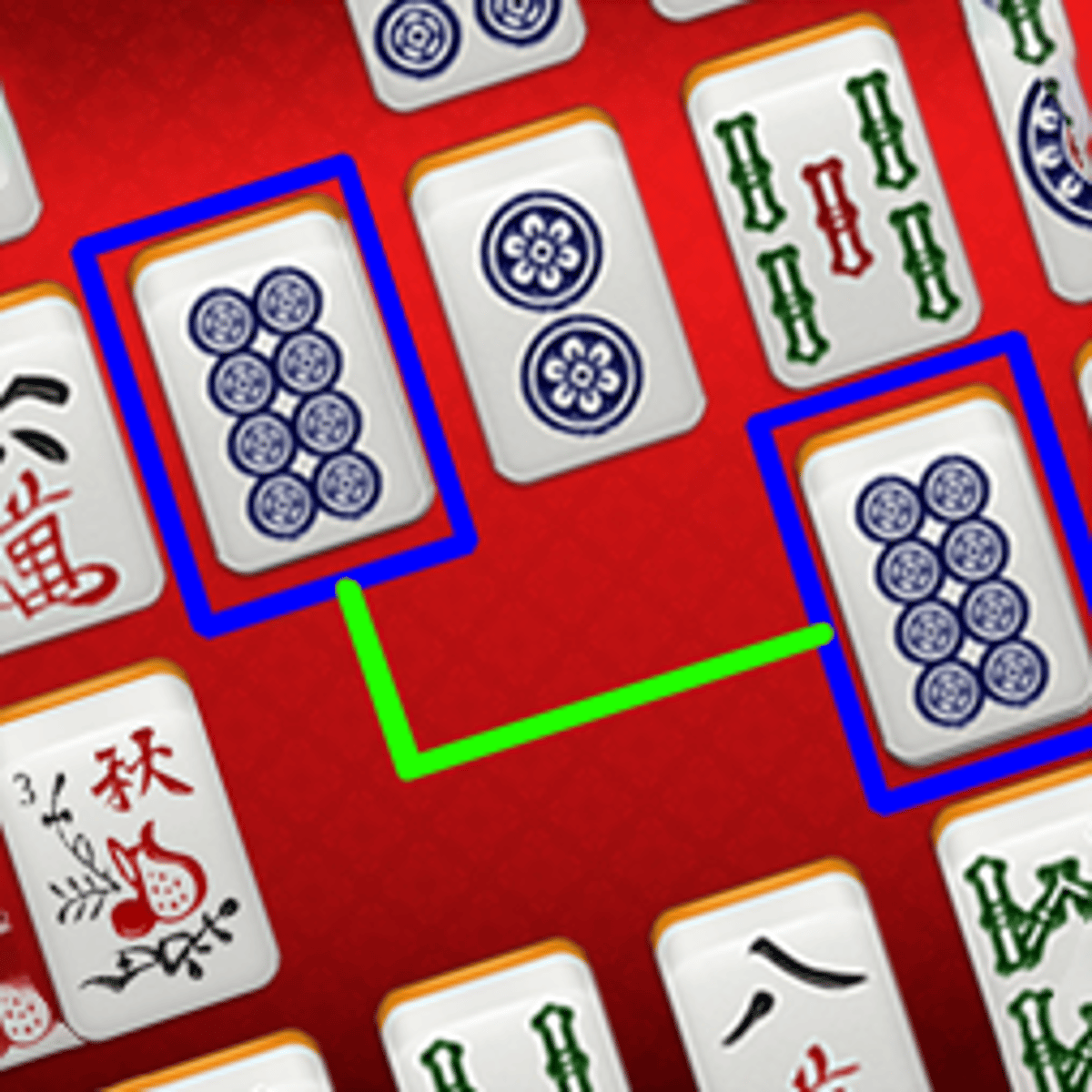
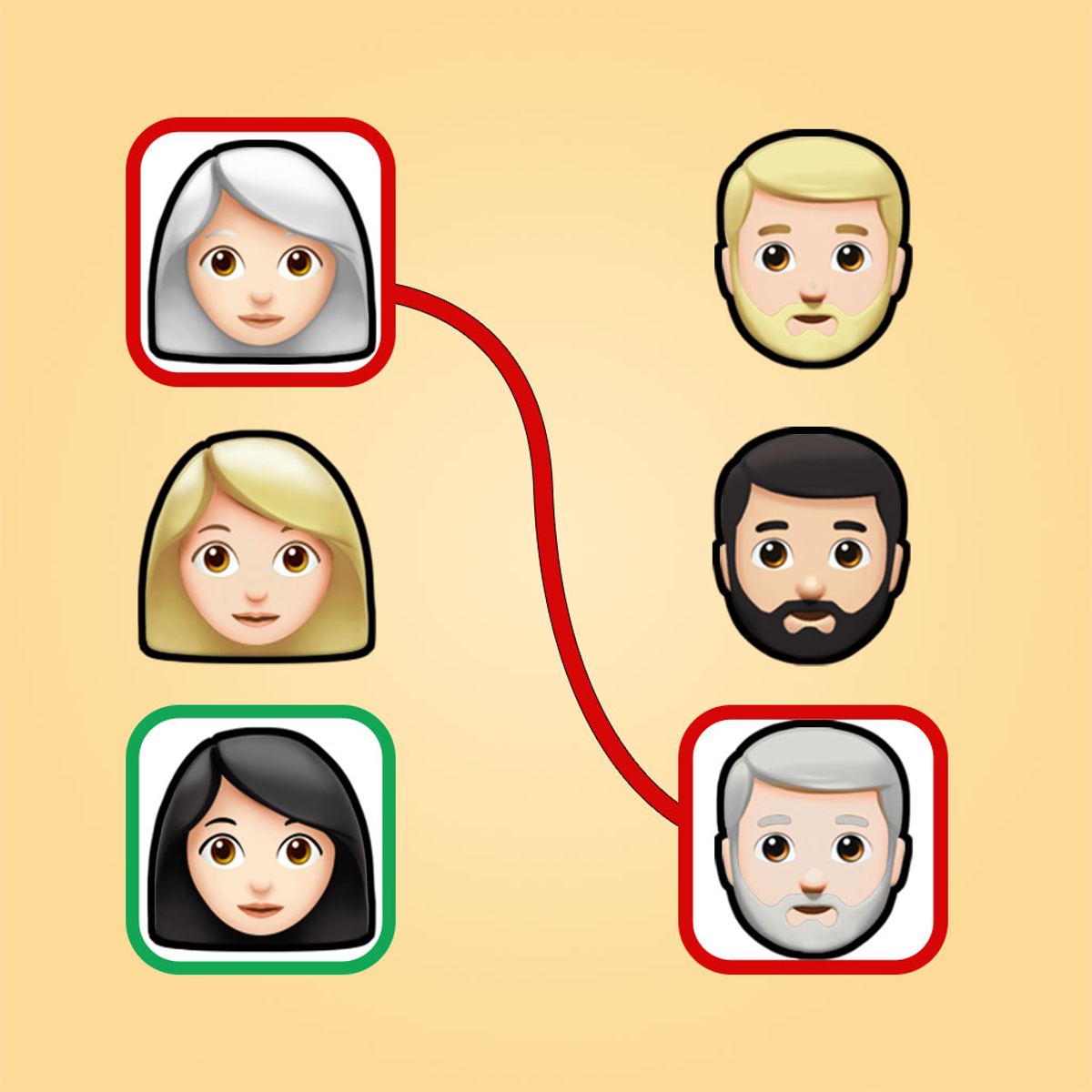
The objective is straightforward: find two identical icons and connect them with a line. The line can't pass through other tiles, and it can turn at most twice. So the path can have zero, one, or two right-angle bends. If you can draw that line without crossing any other icon, the pair disappears. Clear the entire board before the timer runs out, and you win the level.
Let's break that down with a concrete example. Imagine a 6x6 grid. You spot two pineapples: one in the top-left corner (row 1, column 1) and another three cells to the right (row 1, column 4). The space between them is empty—no tiles in columns 2 and 3. That's a zero-bend match: a straight horizontal line. Easy. Now suppose the second pineapple is at row 3, column 4. To connect them, you'd go down from the first to row 3 (vertical), then right to column 4 (horizontal). That's one bend. Still valid. A two-bend path: from the first pineapple, go right two cells, then down two rows, then left one cell. As long as those segments don't cross any other tiles, the match works. If the path would need three bends—say, to go around a cluster—the match is invalid.
On desktop, you play with a mouse. Click the first tile, then click the matching tile. If the connection is valid, both vanish with a soft chime. If not, nothing happens—you just try again. No penalty for failed attempts, so feel free to experiment. On mobile or tablet, it's the same: tap the first tile, then tap its match. The game was built for touch from the start, and the controls feel just as responsive on a phone screen as on a laptop. I've played it on an iPad with a stylus and on a cheap Android phone with my thumb—both work fine.
The board is a grid of tropical-themed icons: fruits, flowers, animals, and little symbols like seashells and suns. Each level has a different layout, and the timer adds urgency. You can see your remaining time at the top of the screen, a countdown in seconds. When it hits zero, the game ends—unless you've cleared the board, in which case you move on. The timer starts at around 90 seconds for early levels and shrinks to 60 or even 45 for later ones. Some levels also have a "bonus time" mechanic: clear a certain number of tiles quickly, and you might earn a few extra seconds. It's not advertised, but it's there.
There's also a hint button. It highlights a valid pair if you're stuck. Use it sparingly—it costs a few seconds off the clock. A shuffle button rearranges all remaining tiles, which can break a deadlock when no matches are possible. Again, it costs time—about 5 seconds, give or take. Managing those penalties is part of the challenge. You only get one hint and one shuffle per level, so you can't spam them.
Game Modes and Features
Onet Paradise doesn't overload you with modes. It's a single, continuous campaign of levels that gradually increase in difficulty. Early boards are small and forgiving—maybe a 6x6 grid with plenty of matches. Later boards get larger, with more tiles crammed into the same space, and the timer gets tighter. You'll also encounter layouts where tiles are stacked or partially hidden behind others, forcing you to clear certain pairs before others become accessible.
The progression is linear: finish level 1, unlock level 2, and so on. No star rating or score to chase—just pass/fail. That simplicity is refreshing. You're not punished for barely scraping by; a win is a win. The difficulty curve is gentle at first, then spikes around level 20 or so. I remember one level where the board was a 10x8 grid with only three pairs of each icon, and the timer was 60 seconds. I failed it four times before I figured out the right order to clear tiles.
The tropical theme isn't just cosmetic. The icons are bright and distinct, which helps when you're scanning quickly. No confusing a red hibiscus with a pink flamingo. The sound effects are minimal—a pleasant chime on a match, a low buzz when you're running out of time. The background music is a chill, looped tune that doesn't get in the way. You can turn it off if you prefer silence. I usually mute the music after a few levels because it gets repetitive, but the sound effects are worth keeping for the feedback.
One feature worth mentioning: the game saves your progress automatically. Close the browser and come back later, and you'll resume exactly where you left off. No login required, no account needed. That's a small thing, but it makes a big difference for casual play. Play a level on your lunch break, close the tab, and pick it up the next day without losing your place.
There are no in-app purchases, no ads that interrupt gameplay (though there may be ads between levels or on the menu screen). It's a free-to-play browser game that respects your time. Play as much as you want without hitting a paywall. The only downside: no leaderboard or social features. It's a solitary experience, which is fine for a puzzle game, but some people like to compare times with friends.
Tips and Strategies
Onet Paradise looks simple, but the timer adds pressure. Here's how to get better.
Scan the board before you click. Don't just grab the first match you see. Take a couple of seconds to look at the whole layout. Identify pairs that are easy to connect—tiles near each other, or tiles with a clear path. Then start with those. Clearing easy matches early opens up space for harder ones later. For example, if you see two coconuts right next to each other in the center, take them first. That might free up a path for a pair of flamingos that were blocked.
Plan your path mentally. A match is only valid if the connecting line turns no more than twice. So you can't just match any two identical tiles; they have to be reachable. A tile in the top-left corner might only be connectable to another in the same row or column, or one a few steps away with a single bend. If you're unsure, trace the path with your finger or cursor before clicking. I've lost count of how many times I clicked a pair that looked valid, only to realize the path would cross another tile. That wasted click costs a second or two.
Use the hint button as a last resort. It costs time, and it only shows one possible match—not necessarily the best one. If you're truly stuck, it's better to use the shuffle button first. Shuffling rearranges all tiles, which can create new matches and break deadlocks. The time penalty for shuffling is smaller than the penalty for staring at the board for thirty seconds. But don't shuffle too early either. Sometimes a deadlock is just a mental block—you might miss a match that's right in front of you.
Work from the outside in. Tiles on the edges and corners are harder to match because they have fewer neighbors. Clear them early, before they get boxed in. If you leave a corner tile for last, you might find it has no valid match at all. I once had a level where the last two tiles were both pineapples, but they were in opposite corners with a wall of other tiles between them. No path existed—I had to restart. Clear the edges first.
Don't panic when the timer gets low. The game doesn't punish fast clicking, but it does punish mistakes. Click a wrong pair, and you waste time. Stay calm. Focus on finding one good match at a time. The last few seconds can feel frantic, but a clear head beats a fast finger. When the timer hits 10 seconds, I take a deep breath and look for the simplest possible match—ideally two tiles right next to each other. If I can't find one, I just start clicking any pair that looks plausible. Sometimes luck works.
Learn to recognize patterns. After a few levels, you'll notice that certain layouts repeat. The same arrangement of pineapples and parrots might show up in different levels. Once you've solved a pattern once, you can solve it faster the next time. For instance, there's a common layout where the board is shaped like a cross, with tiles only in the center rows and columns. The corners are empty. In that layout, you need to clear the center tiles first to open paths to the outer ones.
Use the shuffle button strategically. If you see that only two or three matches are possible, and they're all hard to reach, shuffle immediately. Don't wait until you're completely stuck. A fresh board is often easier than a nearly empty one with awkward tiles. But be careful: shuffling doesn't guarantee a solvable board. Sometimes you shuffle and still end up with no matches. In that case, you have to use the hint button or restart.
Prioritize matches that open up the board. Some tiles are "gatekeepers"—they block access to several other tiles. If you see a pair that, when removed, will create a clear path to a cluster of other matches, take that pair first. It's like solving a jigsaw puzzle: you want to unlock the biggest sections early.
Common Mistakes
New players tend to make the same errors. Here's what to watch out for.
Clicking too fast. The most common mistake is rushing. You see two identical tiles, you click them without checking the path, and nothing happens. That wastes a second or two. Slow down just a little. Confirm the connection is valid before you click the second tile. I've seen players click the same tile twice because they were in a hurry—that does nothing.
Ignoring the timer. Some players get so focused on matching that they forget to glance at the clock. Then suddenly they're in the red zone with half the board still full. Keep an eye on the timer. If it's running low, prioritize quick, easy matches, even if they're not the most strategic. A simple match near the center is better than a complex two-bend match on the edge.
Forgetting that tiles can be blocked. A tile might be visually clear but still unreachable because the path would have to cross another tile. Remember: the line can't go through any other icon, even if that icon is far away. The path must travel through empty spaces only. I've seen players try to match two tiles separated by a single tile in between—that's a three-bend path, invalid. The game won't let you do it, but you might waste time trying.
Using hints too early. The hint button is tempting when you're stuck, but it costs time. If you use it in the first ten seconds of a level, you're already behind. Try to find matches on your own for at least the first half of the timer. The hint is there for emergencies, not as a crutch.
Not using shuffle when needed. Some players stubbornly refuse to shuffle, thinking they can find a match if they just look harder. But sometimes the board is genuinely deadlocked—no two identical tiles can connect. In that case, shuffling is the only option. Don't waste thirty seconds staring at a dead board. If you've scanned the board twice and found no valid matches, shuffle immediately.
Matching tiles that are too far apart. Even if a connection is technically valid, a long path with two bends takes more time to trace mentally. It's often faster to clear a few nearby pairs first, then come back to the distant ones. Efficiency matters. For example, if you have a pair of suns at opposite ends of the board, and a pair of seashells right next to each other, take the seashells first. The suns will still be there later, and the board will be emptier, making the path easier.
FAQ
Is Onet Paradise free to play?
Yes, completely free. Play it in your browser without downloading anything. No pay-to-win mechanics.
Can I play on my phone?
Absolutely. The game works on both desktop and mobile browsers. Touch controls are smooth, and the interface scales to fit your screen. I've played it on an iPhone SE and a Samsung Galaxy—both worked without issues.
What happens if the timer runs out?
You lose the level and have to restart it. No penalty beyond that—you can try again as many times as you want. The game doesn't track your failures, so no shame in retrying.
How do I get more hints or shuffles?
You don't earn extra hints or shuffles. Each level gives you one hint button and one shuffle button. Using either costs a few seconds off the clock. You can't buy more. That's it—one of each per level.
Is there an end to the game?
Yes, there are many levels, but the game has a finite campaign. You'll face increasingly difficult boards until you clear the final one. After that, you can replay any level you like. No endless mode, which is a bit of a letdown for players who want to keep going forever.
Does the game have leaderboards or achievements?
No. Onet Paradise is a straightforward single-player experience. No leaderboards, no achievements, no social sharing. If you need external validation, this game won't provide it. But if you just want to relax and solve puzzles, it's perfect.
Can I play offline?
Since it's a browser game, you need an internet connection to load it. But once loaded, it runs locally—you can disconnect and still play the current level. However, if you refresh the page or close the tab, you'll need to reconnect to save progress.
##
Onet Paradise isn't trying to reinvent the puzzle wheel. It's a polished, colorful, and addictive matching game that does exactly what it sets out to do. If you've got five minutes to kill—or fifty—give it a click. Just don't blame me when you lose track of time. The tropical vibes, the satisfying chime of a match, the tension of a near-empty timer—it all adds up to a game that's easy to pick up and hard to put down. Whether you're a veteran of Mahjong Connect clones or a complete newbie, Onet Paradise offers a clean, frustration-free experience that respects your time and your brain. Give it a shot. You might find yourself coming back for "just one more level" long after you should have gone to bed.