



Brain Test Special
Some puzzle games make you feel smart. Brain Test Special makes you feel like a genius for about three seconds, then immediately reminds you that you’re an idiot who just tried to unlock a door by tapping the key fifty times. It’s a collection of short, absurd brain teasers that rely on trickery, misdirection, and the kind of logic that only makes sense after you’ve already failed. That’s why people keep coming back.
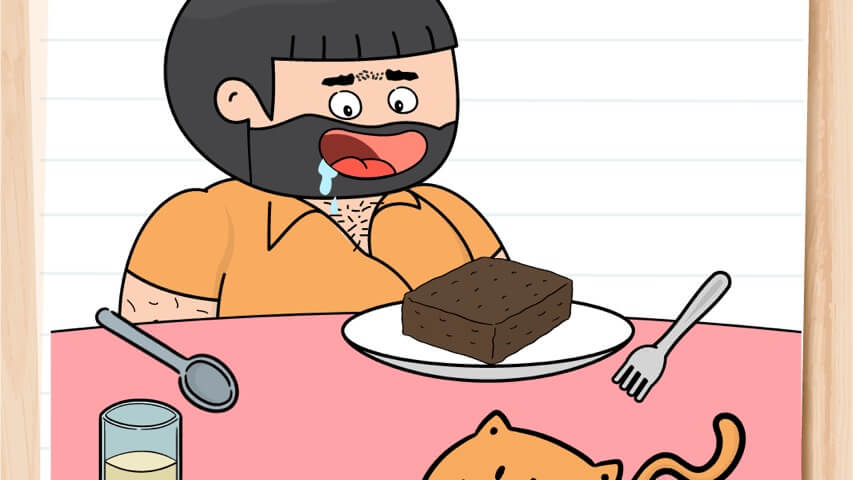
Developed by Unico Studio, the same team behind the long-running Brain Test series, this entry doesn’t reinvent the formula. It just keeps finding new ways to make you feel foolish. Each level presents a simple question or scenario—like “How many holes are in this shirt?” or “Help the cat get the fish”—and the answer is almost never what you expect. You might need to tap a hidden spot, drag an object that looks like decoration, or even turn your phone upside down. The game rewards curiosity and punishes overconfidence.
What makes it work is the pacing. Levels take maybe thirty seconds once you know the trick, but you can spend five minutes banging your head against the screen before that “aha” moment hits. The humor helps, too. The animations are goofy, the sound effects are obnoxious in a charming way, and the game never takes itself seriously. It’s the kind of experience you play in short bursts—waiting for a bus, during a commercial break, or when you need a break from actual thinking.
How to Play
The objective is straightforward: solve each puzzle by figuring out what the game wants you to do. The instructions on screen are often misleading, incomplete, or outright lies. Your job is to ignore the obvious and try the ridiculous.
On desktop, use your mouse to click and interact with objects. You can also click and drag items to move them around the screen. Some puzzles require you to combine objects by dragging one onto another, or to hold a click for a few seconds. There’s no keyboard input needed—everything is point-and-click.
On mobile, tap to interact and drag with your finger. The controls are identical in function, just touch-based. Because many puzzles rely on device orientation, you might need to rotate your phone or tablet to trigger certain events. The game doesn’t always tell you when to do this, so if you’re stuck, try tilting your device.
No timer, no score, no penalty for wrong answers. You can try as many times as you want, and the game doesn’t punish experimentation. Experimentation is the whole point. If you tap on everything and drag every object, you’ll eventually stumble onto the solution. The challenge is that the solution is often something you’d never think to try in a normal game.
Features
Brain Test Special doesn’t have traditional game modes like “campaign” or “endless.” It’s a linear sequence of levels, each one a self-contained puzzle. But a few aspects shape the experience.
Hundreds of levels. The game has a large number of puzzles, and Unico Studio has been adding more over time. You won’t run out of content quickly, and the difficulty ramps up gradually. Early levels teach you the basic tricks—tap the wrong thing, drag the obvious item—before throwing in more layered nonsense.
Hint system. If you’re truly stuck, you can use a hint. It usually highlights the area you need to interact with or gives a vague nudge. Hints are limited, so you can’t rely on them for every puzzle. The game wants you to figure it out yourself, but it’s not cruel about it.
No time pressure. This is a puzzle game for people who hate timers. You can sit and stare at a level for ten minutes if you want. The only pressure is your own frustration.
Funny animations and sound. The game has a distinct sense of humor: characters make silly faces, objects bounce around, and the sound effects are deliberately goofy. It’s not high art, but it keeps things light when you’re stuck.
Cross-platform. You can play on a computer, phone, or tablet, and the experience is essentially the same. The touch controls on mobile feel slightly more natural for dragging, but desktop works fine too.
Tips and Strategies
After spending time with Brain Test Special, a few patterns emerge. Here’s what helps.
Read the question twice, then ignore it. The text on screen is often a trap. For example, a level might ask “How many apples are there?” while showing three apples and a banana. The answer might be three, or it might be four if you count the one in the question itself. The game loves wordplay, so pay attention to the phrasing, not just the picture.
Tap everything. Seriously. Tap the background, tap the character’s face, tap the title at the top of the screen. Some puzzles hide interactive elements in plain sight. If you see something that looks like decoration, it’s probably not decoration.
Drag objects that seem fixed. Many puzzles have items that appear to be part of the background—a cloud, a tree, a piece of furniture. Try dragging them anyway. Sometimes you can move them to reveal something underneath, or combine them with another object.
Shake your device. On mobile, tilting or shaking your phone can trigger events. On desktop, there’s no equivalent, so the game usually provides an alternative (like clicking a specific spot). But if you’re playing on a phone and nothing works, try rotating the screen.
Use hints sparingly. The hint system gives you a limited number of free hints. Save them for levels where you’ve tried everything and still can’t figure it out. Often, the hint just confirms what you already suspected but didn’t try.
Think like a five-year-old. The solutions are rarely logical in an adult sense. They’re more like the kind of trick a child would pull: “Oh, you thought you had to solve the math problem? Actually, you just had to tap the word ‘problem’.” Let go of your expectations and try the dumbest thing you can think of.
If you’re stuck, walk away. Sometimes the answer comes to you when you’re not looking. I’ve solved several puzzles while brushing my teeth. The brain works on problems in the background, and a fresh perspective often reveals the trick.
Common Mistakes
New players tend to fall into the same traps. Here are the biggest.
Overthinking. The most common mistake is assuming the puzzle is harder than it is. You might spend five minutes trying to calculate a complex equation when the real answer is to tap the “=” sign. The game is designed to make you feel clever after you fail, so don’t assume complexity.
Ignoring the question text. The text isn’t just flavor. It often contains the solution. For example, a level might say “How many holes are in this shirt?” and the shirt has six obvious holes, but the answer is eight because the neck and bottom count as holes too. The wording is deliberate.
Not trying to drag. Many players click or tap once and then give up. But dragging is a core mechanic. If you see an object, try to move it. Even if it looks like it’s part of the background, try. I’ve seen people stuck on a level for ten minutes because they never tried to drag a cloud that was actually a movable object.
Forgetting to check the edges. Some interactive elements are placed at the very edge of the screen, partially hidden. On mobile, you might need to scroll or swipe to reveal them. On desktop, check the corners.
Giving up too early. The game is designed to frustrate you, but the solution is always simple once you see it. If you’ve tried ten things and none worked, try ten more. The answer is there. It’s just hidden behind your own assumptions.
FAQ
Is Brain Test Special free to play?
Yes, you can play it for free on websites like Poki. There are no paywalls, though you might see ads between levels.
Can I play on my phone?
Absolutely. It works on both iOS and Android devices through a browser. The touch controls are smooth, and the game is optimized for smaller screens.
How many levels are there?
The game has a large number of puzzles, and the developers have added more over time. It’s enough to keep you busy for several hours, especially if you get stuck on a few.
Do I need an internet connection?
You need an internet connection to load the game, but once it’s running, it doesn’t require constant online access. However, since it’s browser-based, you’ll need to stay connected to keep playing.
Is this game similar to other Brain Test games?
Yes, it’s in the same vein. If you’ve played Brain Test: Tricky Puzzles or Brain Test 2, you’ll recognize the style. This one feels like a compilation of the best tricks from the series, with a few new ideas thrown in.
---
Brain Test Special isn’t trying to be a deep, meaningful puzzle game. It’s a collection of jokes, some of which you have to work for. If you enjoy having your brain twisted into knots and then laughing at yourself, it’s worth a few hours of your time. Just don’t expect to feel smart when you’re done.