



Samurai Sam
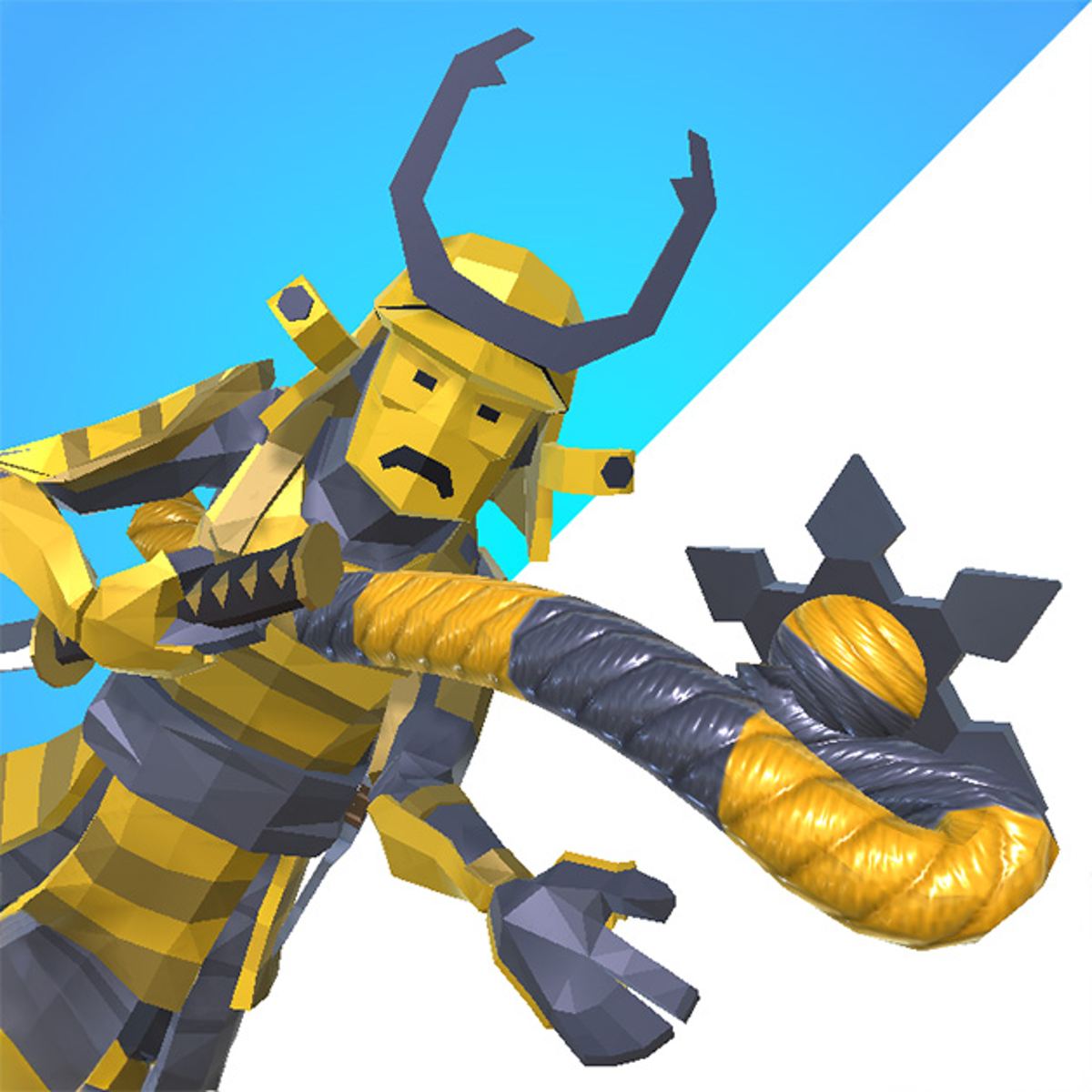
You swing a grappling hook, fling yourself into enemies, and watch them explode into a ragdoll mess. Samurai Sam is exactly that, and it’s more addictive than you’d expect. You play as a little samurai with a hookshot and a weapon that gets increasingly ridiculous. The whole thing runs on physics—unpredictable, sometimes hilarious physics—so no two swings feel the same. One moment you’re gracefully arcing over a pit, the next you’ve face-planted into a wall and taken out three enemies by accident. That chaos keeps people coming back.
The game doesn’t try to be a deep narrative experience. It’s pure action: grab, swing, smash, repeat. But the core loop is tight, and the gradual weapon unlocks (from a basic katana to a giant axe that hits like a freight train) give you something to work toward. If you’ve ever spent an hour in Stickman Hook or Ragdoll Hit and thought, “I wish I could also slice people up,” this is your fix. It’s fast, cartoonishly violent, and runs right in your browser. No download, no fuss.
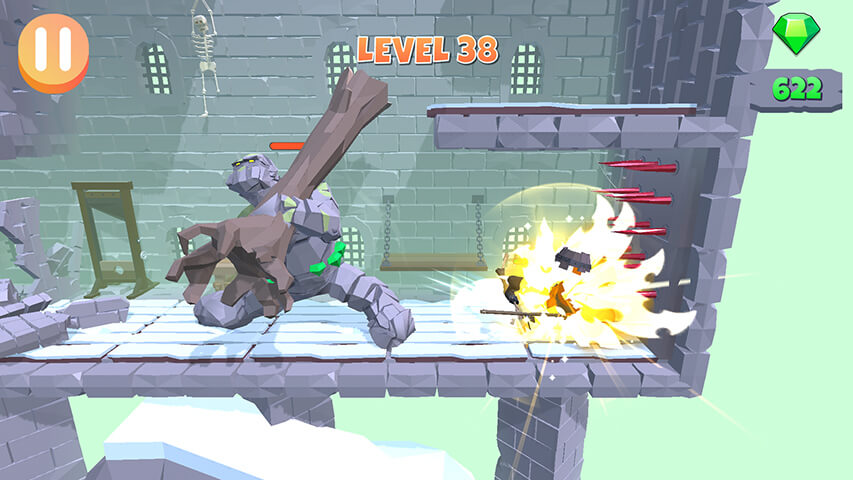
What sells it is the weight of everything. When you swing into a group of enemies, they don’t just disappear—they fly backward, bounce off walls, and sometimes take out their buddies in a chain reaction. I’ve had moments where one well-placed swing cleared half a level because the first enemy hit a second, who tumbled into a third, and they all ended up in a spike pit. The physics engine treats each body as an object with mass and momentum, so every collision feels earned. That’s the kind of chaos that makes you laugh out loud and immediately want to try again.
The visual style is clean and simple—flat colors, minimal detail—but it works. Animations are snappy, and the blood effects are cartoonish enough to keep things light. You won’t be disturbed by the violence; it’s more like watching a Looney Tunes short where someone gets flattened by a piano. The sound design is equally straightforward: a satisfying thwip when you fire the hook, a thud when you land, and a crunchy smack when you connect with an enemy. Nothing fancy, but it all fits.
How to Play
The objective is straightforward: swing through each level and kill every enemy standing between you and the exit. But how you do that is where the fun lives. You have a grappling hook that attaches to almost any surface—walls, ceilings, platforms, even enemies if you’re lucky. Once you’re hooked, you can swing, build momentum, and release at the right moment to send Sam flying into the nearest bad guy. Your equipped weapon does the rest.
Desktop controls: Click and hold your mouse button anywhere on the screen to aim the hook. A line shows you where it’ll attach. Release to fire the hook. While swinging, you can release the hook again mid-air by letting go of the button. That’s it. You don’t move Sam directly; the physics does the work. It’s all about aiming and timing.
But there’s more nuance than that first impression suggests. The hook doesn’t just attach to a point—it creates a rope with real tension. If you swing low, the rope goes slack and you lose momentum. If you swing high, you can build a pendulum effect that carries you across huge gaps. The key is to aim for points above your current position, then let gravity do the work. A common rookie mistake is to hook a point directly in front of you. That just pulls you straight toward it with no arc. Instead, aim for a point above and to the side, so you swing like Tarzan.
Mobile controls: Touch and drag on the screen to aim, then lift your finger to shoot. It works surprisingly well on a phone because the gesture feels natural—like you’re flicking the hook out. The game scales down nicely, though I’d recommend playing on a tablet if you have one, just for the extra aiming precision. On a small phone screen, it’s easy to accidentally hook the wrong surface, especially in tight spaces. Take an extra half-second to aim carefully.
A quick note: Sam is a ragdoll, so he flops around when you land or get hit. Don’t expect tight platforming control—that’s the point. You’re meant to feel the weight and momentum. Embrace the flop. But here’s a trick: if you hold the hook while you’re still in the air after a swing, you can cancel some of the ragdoll wobble and land more cleanly. It’s not a perfect fix, but it helps when you need to chain swings quickly.
You can also use the hook to pull yourself out of danger. If you’re falling toward a spike pit, fire the hook at a nearby wall or ceiling. The rope will yank you sideways, potentially saving your life. It takes practice to do it in the heat of the moment, but once you get the reflex down, you’ll survive a lot more levels.
Features and Progression
Samurai Sam doesn’t have separate “game modes” in the traditional sense, but it does have a steady progression system that acts as the main draw. You start with a basic katana. It’s fine—gets the job done—but after a few levels you unlock the naginata (a long polearm), then throwing axes, and eventually a massive great axe. Each weapon changes how you approach combat. The katana is quick but has short reach; the great axe is slow but one-shots almost everything and sends bodies flying. I found myself favoring the throwing axes because they let you stay mobile, but the great axe is pure satisfaction when you land a full-speed swing.
Let me break down the weapons in more detail, because they’re not just cosmetic upgrades.
- Katana: Your starter weapon. It’s fast, has a decent swing arc, and does moderate damage. You can kill most basic enemies in one hit if you’re moving fast enough, but it struggles against armored foes (which appear around level 10). The katana’s real strength is its speed—you can swing, recover, and swing again quickly, which helps when you’re surrounded. It’s also the most forgiving weapon for learning the game’s rhythm.
- Naginata: A longer polearm with a wider swing arc. It takes a fraction of a second longer to swing, but the extra reach means you can hit enemies from farther away. This is great for poking at enemies while staying out of their attack range. The naginata also has a slight knockback effect, so enemies you hit tend to stumble backward. It’s my go-to for levels with narrow corridors, where you can’t afford to get close.
- Throwing Axes: These are a game-changer. Instead of a melee swing, you throw an axe that arcs through the air. It does heavy damage and can hit multiple enemies if they’re lined up. The downside is that you have to retrieve the axe after throwing it, or wait for it to reappear after a short cooldown. The throwing axes reward precision and planning. I love using them from a high vantage point: hook a ceiling, swing up, then release and throw the axe while you’re still airborne. It feels like a sniper shot.
- Great Axe: The final weapon, and it’s absurd. It’s massive, slow, and has a wind-up animation that leaves you vulnerable. But if you connect with an enemy at full speed, they explode into a cloud of pixels. The great axe also has a huge hitbox—it can clear a group of three or four enemies in one swing. The trade-off is that if you miss, you’re stuck in recovery frames and will probably get hit. Use this weapon when you’re confident in your aim and you want maximum carnage.
There are also environmental hazards: spikes, pits, explosive barrels, swinging blades. You can use your hook to pull those hazards into enemies or swing an explosive barrel into a crowd. The game encourages creativity. It’s not just “hit the enemy until it dies”—you can drop chandeliers, trigger traps, or use your own momentum to become a human battering ram.
Levels are short and linear, but they ramp up in difficulty. Later stages introduce more enemies, tighter spaces, and trickier hook placements. You’ll have to chain swings together without touching the ground, which is where the real skill test lies. There’s no multiplayer or leaderboard that I could find, but the single-player campaign has enough content to keep you busy for a few hours.
The level design itself is worth mentioning. Early levels are wide-open arenas with a few enemies scattered around. By the middle of the game, you’ll see vertical shafts, moving platforms, and areas where the floor is completely covered in spikes, forcing you to stay airborne. Some levels have multiple paths—you can go high or low, and each route presents different challenges. The game doesn’t force you to explore, but it rewards curiosity. I found a few secret alcoves that contained extra enemies (which meant more satisfying kills) and once, a hidden weapon upgrade that I’m still not sure was intentional.
Tips and Strategies
You can brute-force your way through the early levels, but the later ones will punish you if you don’t think about your swings. Here’s what I learned after getting wrecked a few times.
Use the environment as a weapon. Don’t just hook enemies directly. Hook a hanging platform above a group of enemies, swing into it, and let the debris take them out. Or hook a heavy object (like a stone block) and drag it into the crowd. The physics engine treats everything with mass, so a big rock moving at speed is basically a bomb. I once cleared an entire room by hooking a chandelier, swinging it back and forth like a wrecking ball, and then releasing it into a cluster of enemies. The chain reaction killed five guys at once. It’s moments like that where the game feels like a physics sandbox rather than a combat game.
Build momentum before engaging. The worst thing you can do is fire your hook while standing still and hope to fly into an enemy. You’ll just dangle there. Instead, take a running start, or swing from a high point to build speed. The faster you’re moving when you hit something, the more damage you deal. A slow tap does almost nothing. There’s a specific technique I call the “slingshot”: hook a point behind you, run forward, then release the hook at the last second. You’ll shoot forward with incredible speed. It takes practice to aim, but it’s devastating when you pull it off.
Aim for the head. Okay, it’s a ragdoll game, so “head” is a loose concept. But hitting an enemy’s upper body seems to send them flying farther and often kills them outright. If you connect with legs or arms, they might just stagger. This is especially true with the katana. With the great axe, it doesn’t matter—you’ll disintegrate anything. For throwing axes, aim slightly above the enemy’s head to account for the arc. You’ll get a feel for it after a few throws.
Don’t forget you can release the hook early. A common instinct is to hold the hook until you naturally reach the end of the rope. But often you want to let go earlier to adjust your trajectory. If you see an enemy below you, release a fraction of a second before you think you should. You’ll drop straight down with full speed instead of swinging past. This is also useful for navigating tight spaces. If you’re swinging toward a narrow gap, release early and you’ll slip through instead of smacking into the wall.
Watch out for spikes. They kill you instantly. Yes, it’s obvious, but when you’re in the middle of a chaotic swing, it’s easy to forget that the floor is lava. Actually, it’s spikes. Same difference. The game loves to place spikes just below a platform you’re meant to land on, so always check your landing zone before you commit. If you see spikes, plan an alternative path—maybe hook a ceiling and swing over them.
Chain your swings. The best players never touch the ground. Once you’re in the air, you can keep hooking new surfaces to maintain momentum. The trick is to release the current hook just before you reach the apex of your swing, then immediately fire a new hook at the next target. It’s like a rhythm game: hook, swing, release, hook, swing, release. If you can keep that chain going, you’ll clear levels in half the time. Start practicing on the early, open levels where you have plenty of room to fail.
Weapon-specific strategies. With the katana, stay aggressive—get in close, hit fast, and move on. With the naginata, keep distance and use the reach to poke at enemies from safety. With throwing axes, find a high spot, throw, then move to a new position while the axe recharges. With the great axe, only swing when you’re sure you’ll connect. A missed great axe swing leaves you wide open for a counterattack.
Common Mistakes
Even experienced physics-game players fall into these traps. I certainly did.
Over-committing to a swing. You hook a distant point, swing across the level, and realize too late that you’re headed straight into a wall of spikes. The panic release doesn’t save you because you have no way to change direction mid-air. The fix: plan your swings one step ahead. Always have a backup hook point in mind. Never swing blindly into the unknown. Before you fire the hook, scan the area for hazards and alternative anchor points. If you see spikes below, aim higher.
Trying to fight every enemy head-on. The game rewards cleverness, not brute force. If you see a group of enemies standing next to a chandelier, don’t run at them. Hook the chandelier, drop it on their heads, and move on. The game is about efficiency, not kill count. (Though the kill count is satisfying.) I wasted a lot of time early on trying to duel each enemy one-on-one. Once I started using the environment, my clear times dropped dramatically.
Forgetting to upgrade your weapon. The game unlocks new weapons automatically after certain levels, but you have to equip them from the menu. I played three levels with the katana after unlocking the naginata because I didn’t notice the change. Don’t be me. Check your loadout every few levels. Also, the game doesn’t tell you when you unlock a new weapon—you have to notice the notification icon. Keep an eye on the top corner of the screen.
Ignoring the mobile controls on desktop. Wait, what? I mean: if you’re playing on a desktop but using a touchscreen laptop, the mobile controls might actually be better. The mouse works fine, but dragging on a touchpad can be imprecise. If you have a touchscreen, use it. The game was clearly designed with touch in mind. On a standard desktop with a mouse, you’ll be fine, but if you’re on a laptop without a mouse, consider switching to touch.
Holding the hook too long. It’s tempting to ride a swing to its full extent, but often you want to release early to change direction or gain height. If you hold until the rope goes slack, you lose all momentum and just hang there. Learn to feel the rhythm of the swing and release at the moment that gives you the best angle.
Panic swinging. When you’re surrounded by enemies and taking damage, it’s easy to spam the hook in random directions. That never works. Instead, take a breath and focus on one escape route. Hook a high point, get out of the crowd, then reassess. The game’s physics punish panic because you’ll just flail and die faster.
FAQ
Is Samurai Sam free to play?
Yes, it’s completely free in your browser. No downloads, no in-app purchases that I encountered. You can play the whole game without spending a cent. There are no ads that interrupt gameplay, either—just a small banner at the bottom of the screen on some sites.
Can I play on mobile?
Absolutely. It works on both phones and tablets. The touch controls are intuitive, and the game runs smoothly on most devices. I tested it on an older Android phone and had no issues. The only downside is that on very small screens, aiming can be tricky in tight spaces. But for casual play, it’s great.
Who made Samurai Sam?
The developer is Viseron. It’s their first game on the Poki platform, and they did a solid job with the physics and feel. I haven’t seen other games from them, but I’ll be keeping an eye out.
How many levels are there?
I counted around 30 levels, though the exact number might vary with updates. It’s enough for a couple of hours of play, and the difficulty curve keeps things interesting throughout. The last few levels are genuinely tough—you’ll need to chain swings perfectly and use every trick in the book.
Does the game have multiplayer?
No, it’s a single-player experience. No co-op, no versus mode. It’s just you and your hook against the world. I think a multiplayer mode where two players compete to clear a level fastest would be amazing, but as it stands, it’s a solo affair.
Why does my character flop around so much?
That’s the ragdoll physics. It’s intentional. You’re not controlling a stiff robot; you’re controlling a limp, floppy samurai who reacts to every impact. Embrace the chaos. It’s what makes the game funny and unpredictable. If you want precise platforming, go play Super Meat Boy. Here, you’re meant to laugh when Sam’s head gets stuck in a wall.
Is there a story?
Not really. The opening screen shows Sam standing in front of a castle, and you’re presumably fighting through enemies to reach some goal. But there’s no dialogue, no cutscenes, no narrative. It’s pure gameplay. Some people might miss a story, but I think it’s fine—the mechanics are the star.
How do I unlock new weapons?
New weapons unlock automatically after completing certain levels. The game doesn’t tell you exactly which level, but you’ll see a notification icon in the menu. Just keep playing, and you’ll get them. The great axe is the last one, around level 20 or so.
Can I replay levels?
Yes, you can go back to any previously completed level from the level select screen. This is useful if you want to try a different weapon or improve your time. There’s no timer or score, but you can challenge yourself to clear a level without touching the ground.
What happens when you die?
You restart the level from the beginning. There are no checkpoints, but levels are short, so it’s not a big deal. You’ll quickly learn the layout and try again. The game doesn’t punish you with a loading screen—it’s instant restart.
Are there any secrets?
I found a few hidden areas that contained extra enemies or alternate paths. Nothing game-changing, but it’s fun to explore. Keep an eye out for suspicious walls or platforms that seem out of place. Hook everything—you never know what might be hiding.
Closing
Samurai Sam doesn’t reinvent the wheel—it just puts a katana in the hand of a physics-based grappling hook game and lets the pieces fall where they may. And those pieces, by the way, often land with a satisfying thud and a cloud of dust. If you’ve got ten minutes to kill or an afternoon to waste, give it a swing. Just watch out for the spikes.
It’s a browser game that understands what makes physics fun: the unpredictability, the creativity, the moments where you accidentally do something amazing and have no idea how to replicate it. You’ll die a lot, but each death is a lesson. And when you finally clear a level with a perfect chain of swings, you’ll feel like a physics god. At least until the next level humbles you.
Go play it. Your inner samurai is waiting.